
Aircraft
Inspire 3
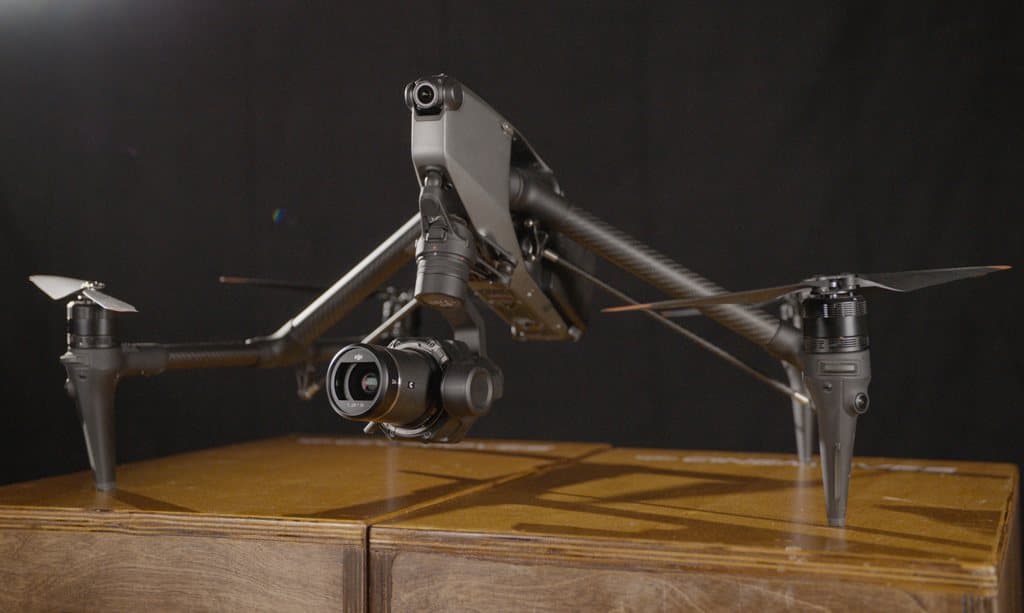
The Inspire 3 is a DJI airframe with the cinema camera built into it, so there is no external camera to rig, balance, or wait on.
It is the aircraft that removes camera build time. That is the trade it makes: agility over payload. When the camera package is the constraint rather than the schedule, the answer is heavy lift.
01Airframe
Specifications
An integrated Zenmuse X9 full frame camera, flown by two operators on separate controls.
Agility
DJI Inspire 3
| Camera | Zenmuse X9 |
|---|---|
| Integrated, not a separate body mounted on a gimbal. | |
| Operators | Two |
| Pilot and camera operator, on separate controls. | |
Camera and crew configuration are confirmed.
Integrated, not mounted
The X9 is part of the aircraft. There is no separate body to mount, no gimbal to balance against a specific lens, and no build step that has to happen before the aircraft can fly.
What is missing
Flight time, top speed, transport footprint, and battery turnaround are not published here yet. Nothing has been estimated in their place. Ask and they will be measured against the configuration being flown.
02Camera
Zenmuse X9
A full frame sensor recording 8K CinemaDNG and 8K ProRes RAW, with dual native ISO at 800 and 4000.
Integrated camera
Zenmuse X9
| Sensor | Full frame |
|---|---|
| Recording | 8K CinemaDNG8K ProRes RAW |
| Dual native ISO | 800 / 4000 |
| Lens mount | DL |
| Interchangeable DL mount lenses. | |
Sensor, formats, ISO and mount are confirmed.
Dual native ISO
Two native sensitivities, 800 and 4000. The second is a clean high sensitivity mode rather than a base sensitivity pushed in post, which is what makes a low light exterior workable without lighting it first.
Raw, both ways
8K CinemaDNG and 8K ProRes RAW. Both carry the latitude a grade needs rather than baking it at capture, so aerial material is not the shot that gives out first in the timeline.
03Fit
What this is right for
The Inspire 3 is right for a day with more setups than time, where the camera package is not the thing under negotiation.
- Days with more setups than the schedule comfortably holds.
- Coverage that has to be in the air quickly and moved often.
- 8K raw acquisition where a separate cinema body is not required.
- Low light exteriors, on the second native ISO.
- Shots where the frame and the flight path both need an operator.
What this is not right for
It is not right for anything that depends on a specific cinema body or a specific lens.
- A shot that has to be captured on the same body as the ground units. The camera is integrated and cannot be swapped.
- Lenses outside the DL mount.
- Anything the aircraft trades away for agility, since payload is what it trades.
- Any plan that needs a flight time, a top speed, or a battery turnaround figure, none of which are published here yet.
04Crew
Dual operator
The Inspire 3 flies with a pilot and a camera operator on separate controls.
Two people, two sets of controls, at the same time. The pilot holds the aircraft and the path. The camera operator holds the frame, and can pan, tilt and adjust independently of where the aircraft is going.
It is the same principle as the rest of the work here. The flying serves the frame, and separating the two controls is what stops one being a consequence of the other.
05Process
What an Inspire 3 day looks like
It runs prep, build, block, shoot, and wrap, with the build step largely removed.
01Prep
Prep confirms the lens and the format, not the camera build.
The camera is part of the aircraft, so what is settled beforehand is which DL lens flies and what the material is being recorded as.
02Build
Build is short, because there is no external camera to balance.
This is the step the Inspire 3 exists to remove. Nothing is rigged onto a gimbal and nothing is balanced against a lens that has not arrived.
03Block
Blocking runs with two operators rather than one.
The pilot and the camera operator work separate controls, so the frame and the flight path are set together rather than one being a consequence of the other.
04Shoot
Shooting runs in short flights, set by battery cycles.
Turnaround between flights is the number that decides how many takes fit in an hour.
05Wrap
Wrap is media offloaded and the aircraft back in its case.
06Questions
Common questions
The questions a coordinator asks before booking, answered directly.
- What camera does the DJI Inspire 3 use?
The Inspire 3 uses an integrated Zenmuse X9 full frame camera.
It is part of the aircraft rather than a separate body on a gimbal, and it takes interchangeable DL mount lenses.
- What formats does the Inspire 3 record?
8K CinemaDNG and 8K ProRes RAW.
Both are raw formats, so the material carries the latitude a grade needs rather than being baked at capture.
- What is dual native ISO on the Inspire 3?
The X9 has two native ISO settings, 800 and 4000.
A second native ISO means the sensor has a clean high sensitivity mode rather than one base sensitivity pushed in post, which is what makes a low light exterior workable.
- Does the Inspire 3 need two operators?
Yes. A pilot and a camera operator work on separate controls.
The frame and the flight path are handled by two people at once, so neither is a by-product of the other.
- Can the Inspire 3 carry a cinema camera like the Alta X?
No. The camera is integrated and cannot be swapped for a separate body.
That is the trade the aircraft makes: agility over payload. When the shot needs a specific cinema body and the lens already chosen, that is heavy lift.
- When would you use the Inspire 3 instead of heavy lift?
When the shot does not need a separate cinema body, and the schedule cannot absorb a camera build.
The Inspire 3 removes the external camera build entirely, so it goes up sooner and moves between setups faster. Heavy lift is the aircraft when the camera package is the constraint.
07Booking
Book the Inspire 3
Send the shot, the lens, and the dates.
The camera is fixed, so the questions worth answering early are the lens, the format, and how many setups the day has to cover.